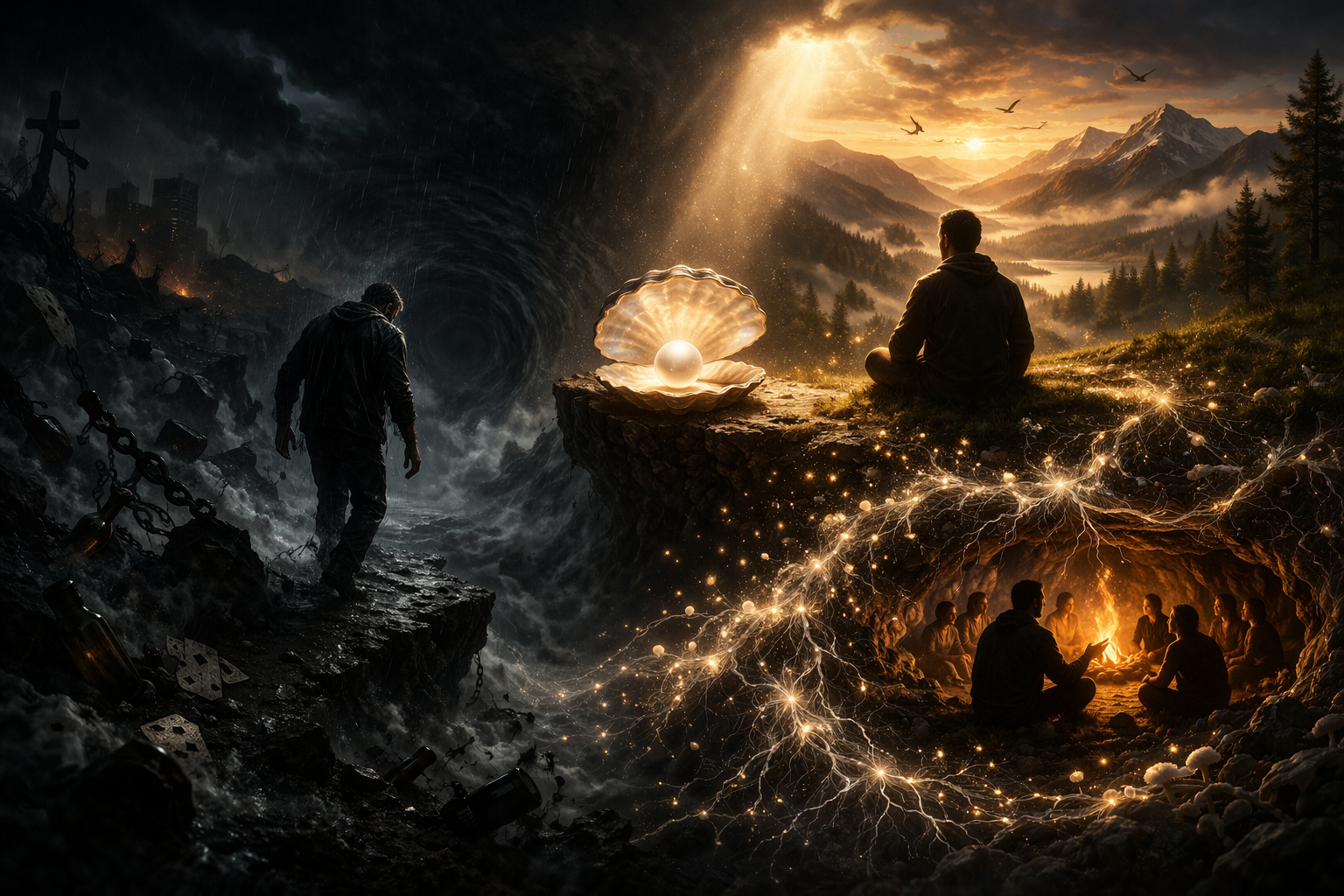
"I descended into the places where men lose themselves forever. But I found something in that darkness. A pearl I wouldn't trade for all the gold in the universe. A knowing that can never be taken away. I found myself ... an authentic relationship with my own self. And that relationship is the treasure. A treasure that no rust or moth can corrupt. Like mycelium threading through dark earth, I share with those receptive what I found ... because the antidote is always in the poison."
"Those who are able to see beyond the shadows and lies of their culture will never be understood, let alone believed, by the masses."
... Plato
Chapter Zero
The Roots
Bedford County & Lynchburg, Virginia
I grew up with one foot in the natural world and one foot in the world of emerging technology. That duality has defined everything since.
The natural world meant the Blue Ridge Mountains of Virginia ... specifically Bedford County and Lynchburg. My father was an outdoorsman, a hunter and fisherman, and also upper-level management in the paper industry. He was an exceptionally good man. The kind of person who treated everyone with such genuine dignity that it caught people off guard ... they couldn't believe someone was being that real.
We built a cabin up on No Business Mountain in Virginia. That's where I spent my summers and falls ... riding 4-wheelers, hunting whitetail deer and turkey. I was always an exceptional hunter. The outdoors was my first education in patience, observation, and understanding systems.
"I used to hunt and fish and spend 200 or more days in the outdoors for years on end. It's been a few years now since I've done it seriously. Sitting still in nature, I remember why I came to Alaska in the first place ... to get away from the bullshit conventional world that told me how to think and how to see."
But I was also obsessed with technology. Before there was an internet, I was running a BBS ... a bulletin board system. I grew up with the first computers: Commodore 64, 1200 baud modems, tape drives, floppy disks. I had this peculiar, coherent vision of where technology was going, and it excited me like nothing else. When I tried to convince people the internet would be big, I was met with incredible resistance. No one saw what I saw.
I couldn't sit still. Exceptionally curious. Science-minded. I questioned everything. I always wanted to figure things out for myself. And that didn't sit well with the religious authority figures in my life ... Lynchburg was Bible Belt heartland. Priests and pastors told me I was going to hell for my curiosity.
"At damn near every turn, everyone and every institution from here to Timbuktu tried to crush that curious spirit out of me. Sit still. Say the right thing. Always never quite right for them."
Throughout my childhood, my excitement wasn't well-received. People didn't see what I saw. People didn't think at the speeds I was thinking. It alienated me. Made me feel isolated. Not immensely, but enough to realize I wasn't "normal." I don't think I've ever been normal.
And there were many times I wished like hell that I was normal.
The Shadow
The Wound
For a long while, I didn't like myself. I had a piss-poor relationship with myself. I didn't want to be me. I wanted to be more ... but I didn't know how to go about it.
So instead, I made up bullshit. This is what people do when they cannot deliver actual value and can't figure themselves out ... they conjure up narratives to make their shortcomings A-OK. That's what I did for years.
Despite being much smarter than most everyone around me, I never felt good enough. I embellished. I performed. I chased external validation without even knowing that's what I was doing.
"I had an unconscious desire for external validation. This was a deep insight for me later in life ... understanding that wound, that hunger, that constant reaching for something outside myself to tell me I was okay."
I didn't understand then that the very things that made me different ... the curiosity, the speed, the refusal to accept conventional answers ... were features, not bugs. That insight would take decades. And it would cost me everything comfortable about my worldview to finally see it.
Chapter One
The Athlete
Late 1980s ... Iowa
I was a left-handed pitcher. Good enough that the Florida Marlins came knocking out of high school. The scouts saw something. A professional future was on the table.
But here's what the scouts didn't see: I was undisciplined. Impulsive. Everything came easy to me ... sports, school, all of it. I was good at a lot of things, so I never had to put in much effort. I was always going to "get to it later."
My dad told me what I should be doing. The coaches told me what I should be doing. I didn't listen. I didn't put in the work. I didn't develop what I now call a psychopathic work ethic until much later in life. By then, for baseball, it was too late.
"If I had been working out properly when I was 12 and 13 ... doing all the things my dad and coaches told me I should be doing ... I would have played in the major leagues. I'm certain of it. But I didn't. And that's a lesson I now teach every young person I mentor."
The real lesson here isn't about baseball. It's about compounding interest ... and not just the economic kind. Compounding interest applies to skills. To development. To who you become.
To make it in the big leagues ... in any sport, any craft, any field ... you have to start building yourself as early as possible and let compounding do its magic. If you don't develop these skills early enough, you don't have enough runway. The doors that compounding interest would have opened for you stay closed.
I believe we only really learn what not to do. We're either going to be a shining example of what to do, or we're going to be an omen of what not to do. In this chapter of my life, I was the omen. And I've made it my mission to make sure the kids I mentor ... including my own sons ... don't repeat that mistake.
Chapter Two
The Pioneer
Early 1990s ... Cedar Rapids, Iowa City, Dubuque
I started one of the first internet service providers in the Midwest. This was before most people knew what the internet was. Before email was normal. Before the web browser changed everything.
We built infrastructure. Connected people. Watched a new world emerge in real-time.
I'd been investing since I was ten years old ... trading on Prodigy, one of the first online services. By the time I sold the ISP in 2000, I'd lived through the first tech boom and learned that being early matters more than being smart.
Chapter Three
The Dark Night
2000s
After the sale, I traveled. The money gave me freedom, and I abused it. I went places most people never go ... and I don't mean geographically.
Drug abuse. Depression. A black hole that kept getting deeper. I battled against truth and integrity for nearly 30 years of my life. All my dishonesty sprang from my inner struggles with insecurity ... not feeling adequate enough for those around me.
"There was a period in my life where I was at the bottom of the bottom, the darkest of dark places. There were many nights where I believed I would not come out alive. I do not wish those circumstances on anyone, ever."
I had been wandering in the desert for four years or so. I explored and experienced the darkest aspects of man and mind. I really didn't expect to make it out alive.
Everyone who'd called me strange, weird, too much ... their voices echoed in that darkness. Maybe they were right. Maybe I was broken. The people around me ... the normal ones, the stable ones ... they seemed to have something I didn't. A peace. A belonging. I had neither.
"Yet the darkness must give way to light. And that is exactly what happened."
Chapter Four
The Satori
And then one evening, something happened.
In a flash, my entire world changed forever. I can recall the event like it was yesterday. I didn't know at the time what it was called or if it had happened to anyone else, ever. The event literally stopped the world as I knew it.
The Buddhists call it satori ... a sudden flash of enlightenment. From one tiny self-question, I was able to stop the world.
"I was blown away by its power, simplicity, and peace of mind. I recall sharing this event with a handful of people, only to be told that it wouldn't last ... that I was on a 'pink cloud' and acting strange. Well, it's lasted. And it turned into something else altogether."
Being exceptionally insecure and self-delusional, I had fought a constant battle with negative self-dialogue. Never good enough. Never enough attention. Always beating the hell out of myself. Yet through the act of realization, I was blessed with the Key that opened the door to Possibility.
I found myself. I established an authentic relationship with my own self ... and it's this authentic relationship with self that's the treasure. A treasure that no rust or moth can corrupt.
The Realization
The Father Mind
What I figured out is this: We are not separate from Source. Not separate from SEED. Not separate from what folks might conveniently call "god." It's really moreso ... that which actually is. I have come to call it The Father Mind, for all is Mind.
"When you realize you are not separate from Source, from Truth, from divinity, from the Cosmos, from each other, from Life and Light itself ... the entirety of everything changes for the Good."
This is the truth that transmutes lead into Gold. This one axiom.
I cannot get others to realize this through clever wordplay and wordsmithing. I can only lead the horse to water. The name of the game is to Realize what is actually happening and what we actually are ... the very fabric of the Cosmos, a fractal of the Living One, of The Father Mind.
The only intelligence there ever is and ever will be. The center of centers from which the primal will to good eternally creates and sustains the Universe. The eternal splendor of the limitless Light.
"I realized the Kingdom of Spirit is embodied in my own flesh."
All the things they called me ... strange, weird, different ... those weren't flaws. They were features. The same wiring that made me an outsider was the wiring that let me see patterns others missed.
"Despite inevitable disbelief, I wouldn't sell my Pearl for all the gold in all the stars in the universe. I wouldn't trade it for billions or all the political power this world has to offer. There's simply nothing like it."
The lead became gold. The darkness became light. What looked like death was actually a doorway.
Chapter Five
The Hermit
Talkeetna, Alaska
After the satori, I needed to rebuild. Not my career or my finances ... myself. So I went to Alaska. To Talkeetna ... a backwoods village in the middle of proper Nowhere. I came up to get away from the bullshit conventional world that told me how to think and how to see.
I found a small cabin with no running water and no electricity. I became a backpack guide, a hunting guide, a fishing guide. I spent 200 or more days in the outdoors for years on end. I learned to be alone without being lonely. I learned that simplicity isn't poverty ... it's clarity.
"I had the time of my life. Most people wouldn't understand. No running water, no electricity, no noise. Sitting still in nature, I remembered why I came to Alaska in the first place ... to get away from the bullshit conventional world that told me how to think and how to see."
Those years stripped away everything that wasn't essential. When you have nothing, you find out what you actually need. Turns out, it's a lot less than you think.
I adore Thoreau. His opening to Walden ... I find it exceptionally similar to my experience. The only perspective we have is our own. He wrote: "I should not talk so much about myself if there were any body else whom I knew as well." I felt the same way.
Chapter Six
The Partnership
Talkeetna → Kenai Peninsula
We met in Talkeetna. She picked me up in a bar ... The Fairview. I'm not quite sure what she saw that day, other than pure old-fashioned rugged good looks. Yet like all chance meetings, little did we know what that bumping into would stir up... or settle down.
"My wife is an incredible human being ... never before have I met someone with such impeccable heart and spirit. As silly as it sounds, I feel like I've searched the cosmos for 10 million light years just to find her. She is home to me."
She had no business giving me the time of day. I was raw, wild, and had little to offer other than my charm. Yet immediately, like in a fairy tale, we knew what was to be. We decided to marry after less than three months. We barely knew each other ... yet we already knew everything we needed to know.
She was working criminal defense ... heavy caseload, complex cases. I started helping with her work. Writing briefs. Developing arguments. Preparing for trial. And something unexpected happened: I discovered I was good at it. Really good.
Legal writing, argumentation, trial strategy ... it all clicked. The same pattern recognition that let me see market opportunities let me see holes in arguments, weaknesses in cases, angles no one else was working.
"In the last ten years, my wife has given me the greatest gifts of my life ... my sons, my grounding, hope in mankind ... and at the deepest level, the very ideal of Unconditional Love. How else could one stay married to me without it?"
Chapter Seven
The Science of Compliance
Working those cases, I developed what I call the Science of Compliance ... understanding what makes people do what they do. Cognitive behavioral psychology. Persuasion architecture. The mechanics of decision-making.
I've always seen the mind like Carl Jung did: as code and components. There's a striking resemblance to how computers and network topology work. Inputs, processing, outputs. Bugs, features, exploits. You see, context governs wisdom. The more we gain resolution ... the more we experience and harvest knowledge from the elements and their interaction ... this creates clarity.
"Understanding how the mind works ... that has always been my superpower. What makes people do what they do. The act of realization ... there is nothing more powerful on this planet. You realize it's light outside, you realize it's dark when the lights are out. Just how much do you and don't you realize?"
I found Charlie Munger's work on mental models and cognitive bias. It resonated immediately ... he was describing a systematic approach to something I'd been doing intuitively. I built on it. Formalized it. Applied it everywhere.
I devoured Cialdini's Psychology of Influence, Kevin Hogan's Science of Influence, Kahneman's Thinking Fast & Slow. The entire gamut of behavioral science. To comprehend the notion that your peace of mind, your inner gold, is an omnipresence that never leaves your side ... that your reaching is merely a waste of activity ... and that if you just stop reaching, the cage dissolves.
Chapter Eight
The Movement Builder
Alaska Cannabis Legalization
When the cannabis legalization movement started in Alaska, I was all in. Not just as an advocate ... as an architect.
This issue was never about getting high. It was a litmus test issue. Do we as community members want our government to micromanage our lives? Our lifestyles? Are we willing to trade our children's liberty and what limited freedom we still cling to ... for a fractionally improved illusion of security and comfort?
"We put men, women and children in jails and prisons for possessing, cultivating, and partaking in one of the most beneficial substances on the planet. We take them away from their integrity, their wives, husbands, mothers, fathers ... and go to bed that night feeling assured we 'got the bad guy.' Well, perhaps YOU are the bad guy."
I organized Town Halls across the state. But not typical Town Halls. I packed them with people who defied the stoner stereotype. Professionals. Parents. Business owners. Judges and attorneys and doctors and teachers who had to hide their use for fear of people who wanted to throw them in jail. I coached them on what to say, how to present, how to make the case.
The strategy was simple: normalize the consumer. Cannabis IS NOT the gateway drug ... dishonesty is. Our system had failed us. We needed an open and honest dialogue.
It worked. Alaska legalized. And from day one, I had a plan: build the state's dominant vertically integrated cannabis enterprise.
Chapter Nine
The Operator
Red Run Cannabis Company ... Present
Red Run Cannabis Company is that vision realized. Cultivation, manufacturing, distribution, retail ... we built the full stack. Alaska's dominant operator in a market that didn't exist a decade ago.
Running a business in a heavily regulated industry isn't for the faint of heart. Payroll taxes. Worker's comp. Federal unemployment. State licenses. AMCO permits. Health department. Fire department. DEC. The government takes first and asks questions never. Small business owners spend more time on insurance renewals and permit renewals than focusing on what actually matters.
"Excuses are meaningless. You can either have excuses or you can have performance ... but you can't have both. I am absolutely sick and tired of mediocre standards from myself and everybody else within my organization."
But here's what I've learned: satisfied customers will go away. Raving fans are here to stay. The difference between mediocrity and excellence is found in the details ... in the culture you build, the people you develop, the standards you hold even when no one is watching.
Leadership isn't about where you come from. It's about where you're willing to go despite the obstacles. The entire point of being in this is to protect and serve ... to develop and produce more abundance for everyone around you. A true leader is first on the field and last to leave it.
Now I'm working on the next frontier: ending psychedelic prohibition in Alaska. Same playbook. Different substance. Same understanding that minds can be changed when you know how minds work.
Chapter Ten
The Present
Today I'm an operator, an investor, a father, and something harder to name. A pattern recognizer. A systems thinker. Someone who went deep into the darkness and came back with notes.
I've been in Bitcoin since the beginning ... not because I was smart, but because I was paying attention. Global macro investing since I was ten years old. Now I'm building with AI agents, treating them as infrastructure rather than novelty.
Three sons. Hockey. Teaching them to think, not what to think. Building a Trust that isn't inheritance ... it's transmitted capacity.
"I have the thing every human being on this planet is actually seeking ... whether they know it or not. I actually have it. I wouldn't trade places with anybody on this planet. Not many people can actually say that."
The Synthesis
Why I'm Telling You This
Everyone told me I was strange. Weird. Too much. They were right. That's exactly why I made it out.
The same thing that made you different is the thing that saves you. The work transmutes us ... from lead into gold, from darkness into light, from poverty into wealth, from death into life.
I'm not a guru seeking followers. I'm a fellow traveler who went deep and came back with notes. What's coming ... AI, decentralization, the complete rewiring of how value works ... will be unsettling and disruptive. The world is going to need all the help it can get.
Now is the time to change it all.
"As above, so below. As within, so without. The patterns that govern markets govern minds. The principles that transform individuals transform systems. It's all one thing, viewed from different angles."
Continue the Journey
The Four Pillars ... Macro Mystic, Truth Seeking, Visionary Father, Decentralization ... are different angles on the same insight. Explore them, or dive into the Journal.